A gift gets opened and someone says, “We should send them a thank you card.” Maybe one even gets bought, one of the blank ones from the grocery store checkout line with a watercolor bird on it. Then it sits on the kitchen counter for a week before disappearing under a stack of mail, a grocery list, and a pair of sunglasses that nobody remembers leaving there.
Eventually, a thank you text gets sent instead.
There is nothing wrong with that, a quick message is certainly better than saying nothing at all, though it is worth admitting most of those texts say some version of “thank you so much!!” and get answered with a thumbs up and that’s the end of it. Still, there is something different about opening an envelope and finding a card someone actually took the time to make. It feels more personal, and it may even get put on the fridge door with a magnet instead of thrown away with the junk mail.
Handmade Thank You Cards Don’t Have to Be Complicated
You can spend longer looking for your tape runner than you do making the card.
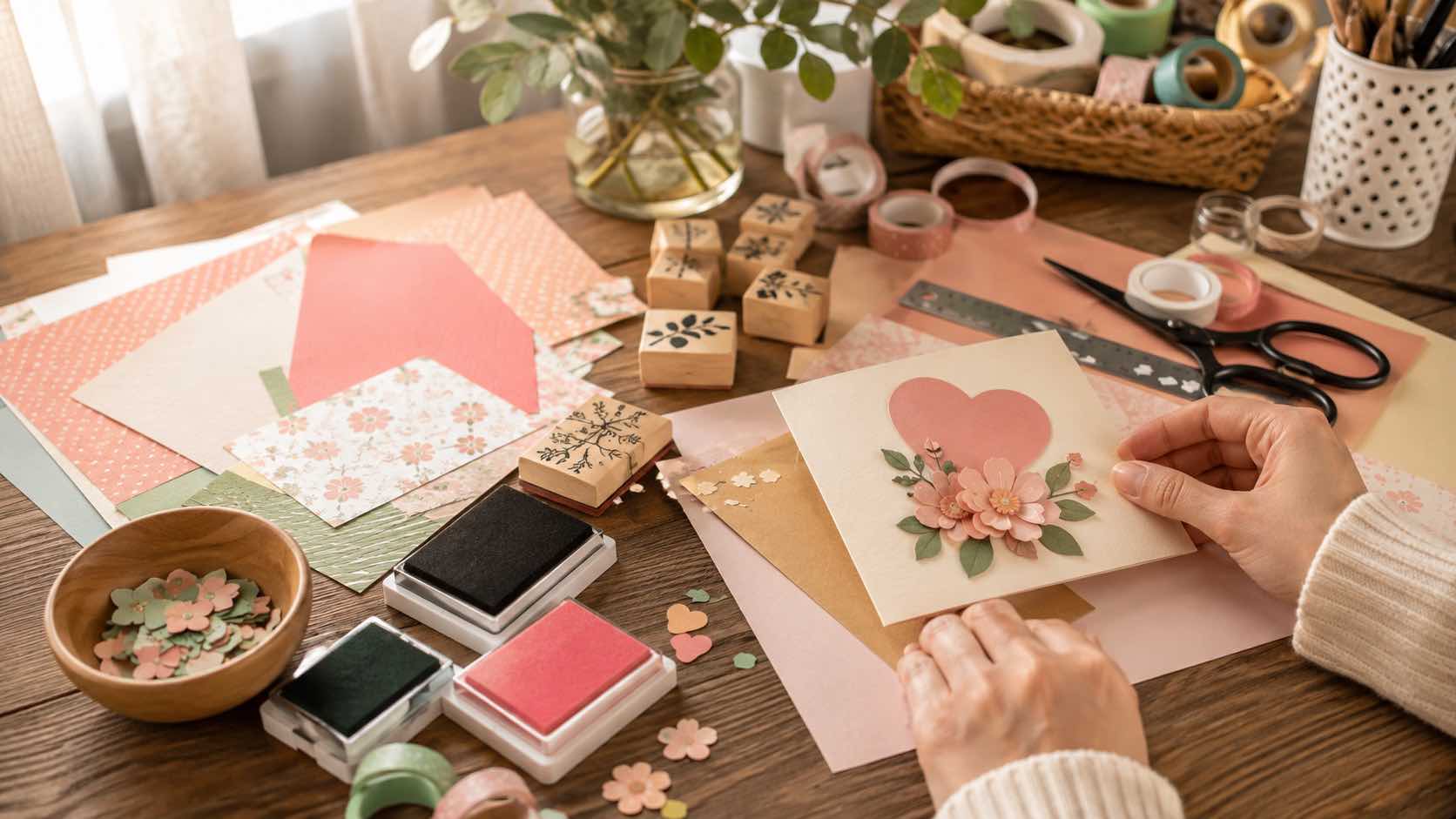
It helps when the supplies are already within reach. When paper, adhesive, stamps, and a handful of embellishments are already sitting together, a thank you card can be one of those projects finished before the coffee has gone cold. Last week one got made in under fifteen minutes for a neighbor who’d dropped off half a lasagna, unannounced, on a Tuesday when nobody had eaten yet. Kraft cardstock, a stamped “thanks a latte” that had been sitting in a drawer since some coffee-themed swap two years back, and a coffee cup die cut in a shade of brown that didn’t quite match anything else on the card. It didn’t need to match. It got mailed anyway.
If you have looked through photos of elaborate handmade cards online, it is easy to assume every project has to be covered in layers, ribbon, tiny paper flowers, and techniques that require a dozen tools. It can feel a little intimidating when you’re just hoping to make one card for a teacher, or whoever watered the plants that one week in July.
Most people never notice whether a card has six layers or one.
They notice the handwritten note inside.
A simple background made from patterned paper, a stamped sentiment, and a small die cut can be enough to make the whole thing feel finished. Sometimes a leftover strip from another project becomes the detail that pulls everything together. Then one day you’re looking for something to fill an empty corner, and suddenly that odd little scrap is exactly the right size.
That pile seems to exist in almost every craft space.
It might be a basket. It might be a drawer that barely closes anymore. There are scraps that looked too nice to throw away, stickers with only one design missing, half a sheet of cardstock, and embellishments bought for a project three years ago that somehow still work today. There’s a strip of washi tape in there too, one with tiny lemons on it, bought for a summer party invitation that never actually got made, and it has now shown up on at least six unrelated cards since.
Nothing says every card has to match. In fact, they probably shouldn’t. Different colors, different papers, different little details are part of what makes handmade cards feel like they were made by an actual person instead of printed by a machine.
If you’re just getting started, there’s no need to buy an entire craft store’s worth of supplies all at once. A small collection is usually enough: cardstock, patterned paper, adhesive, a paper trimmer or scissors, a few stamps, a favorite ink color. As you make more cards, the collection tends to grow on its own. A new paper pad gets added because the colors were too pretty to pass up. A set of dies finds its way home after a weekend craft sale. Before long there’s a shelf that somehow became two shelves, then a rolling cart that was supposed to hold “just the essentials,” and doesn’t anymore.
Card Making Supplies That Get Used Again & Again
Keeping those supplies together also makes a difference. It’s easier to sit down and make a card when everything is already in one place instead of hunting through three rooms for adhesive. Even a small storage cart or a desktop organizer can make crafting feel less like setting up for a major project. Plenty of people end up with a little rolling cart from IKEA or a few storage bins from Target, not because they’re trying to build the perfect craft room, but because it’s easier than wondering where the tape runner wandered off to this time. Though there’s always one stamp set that ends up in the wrong bin anyway and stays there for months.
Why Simple Cards Mean More
The hardest part is simply getting started. You sit down thinking you’ll make one card, and twenty minutes later you’re still deciding which paper looks best with the blue cardstock. Then you change your mind and reach for green instead. Not every creative decision has to happen quickly.
Some cards take a few unexpected turns before they make it to the envelope. Perhaps the stamped image lands a little crooked, or a corner that looked fine at first suddenly feels like it needs something extra. A few things get shifted around, a leftover embellishment gets used, and somehow the card ends up better than the original idea.
Kids are especially good at this. They’re not worried about whether things are centered or on trend. They glue things where they think they belong, add more glitter than most adults would ever consider reasonable, write a heartfelt message, and somehow the finished card ends up being exactly what the person receiving it loves most.
A thank you card was never supposed to be judged like a work of art. It’s just a way of letting someone know they were appreciated. The reason behind it does not have to be complicated. It can be for a moment someone went out of their way, or simply because you wanted them to know their kindness was noticed. The card becomes part of the memory instead of another notification that disappears from a phone screen by the next morning.
Handmade Cards Are Still Worth Sending
Once the supplies are close by, you can just sit down and start. After that, one card tends to turn into two or three, since everything’s already spread across the table anyway, and it seems worth making a few extras for whenever the next occasion comes up.
Maybe that’s why handmade thank you cards still stand out. They aren’t expected anymore. They show up in a mailbox full of bills and advertisements, and for a minute everything else gets ignored. The paper, the stamps, and the embellishments are just the pieces that bring the idea together. What people usually remember is that someone took the time to sit down, make something by hand, and send it.